
Suspended ceiling installation requires reliable fastening solutions to connect ceiling suspension components to suitable structural substrates. In commercial buildings, warehouses, and industrial facilities, contractors need to consider installation efficiency, fastening strength, substrate compatibility, and long-term service conditions. PD Drive Pins with Angle Clip are designed for selected overhead fastening applications, including ceiling wire hangers, lighting supports, and compatible ceiling suspension systems. When matched with the appropriate fastening tool and installation requirements, this type of fastener can help streamline repetitive installation work.
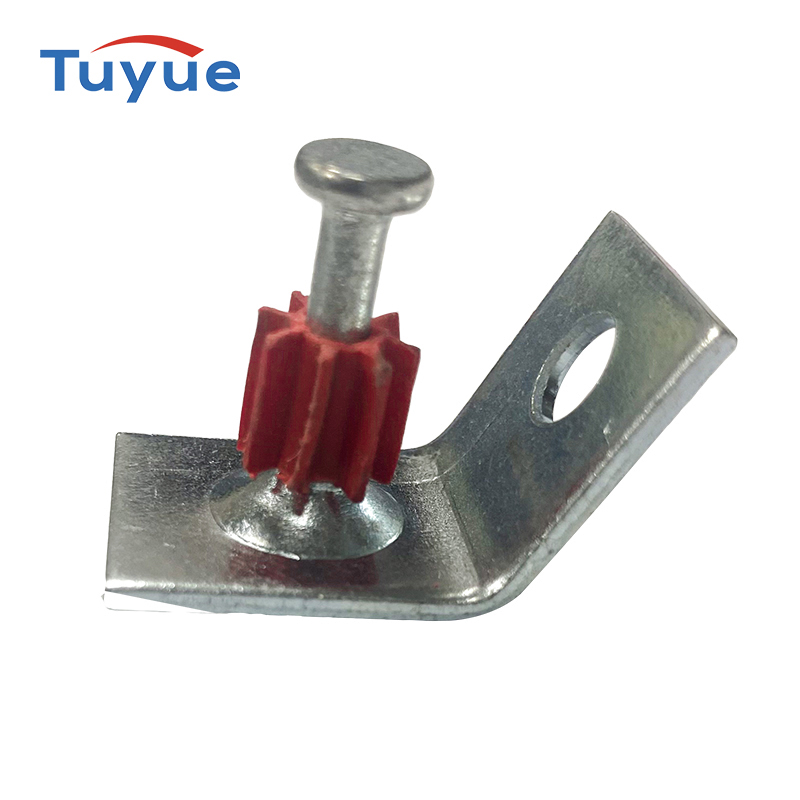
PD drive pins with angle clips combine a steel fastening pin with an angled ceiling clip to support specific suspension and mounting applications. The product featured by Tuyue incorporates a 120-degree angle clip and a plastic flute, with the pin designed for use with compatible powder-actuated fastening tools. Its integrated configuration can simplify the handling of fastening components during installation, although compatibility with the selected ceiling system must be confirmed before use.
According to the product information provided by Tuyue, the pins are made from carbon steel, undergo heat treatment, and feature a zinc-plated finish. These manufacturing processes serve different purposes: heat treatment helps establish the required mechanical properties, while zinc plating provides a protective surface layer against corrosion. The final performance depends on the actual product specifications, coating quality, and installation conditions. View the product details.
Ceiling wire hangers connect the overhead structural substrate to suspension components that support a ceiling framework. In suitable installations, a drive pin with an angle clip can provide an attachment point for compatible hanger hardware. Contractors should select the fastening system according to the substrate, required load, hanger configuration, and applicable installation specifications. Correct positioning and verified holding capacity are particularly important because an overhead connection must safely support the intended ceiling assembly.
Commercial interiors often require mounting points for lighting supports and other ceiling accessories. PD drive pins with angle clips may be considered where their configuration is compatible with the support component and the specified base material. Before installation, contractors should determine whether the fastener is approved for the intended load and whether additional support or an alternative anchoring method is required. Heavy lighting fixtures and safety-critical overhead equipment should never rely on an unverified fastening arrangement.
Metal furring channels help form the framework used in many suspended ceiling assemblies. Appropriate fastening solutions can support the connection between compatible metal components and the underlying structure. During installation, contractors need to consider fastening-point spacing, channel alignment, edge distances, and the properties of the base material. The angle clip should be checked against the intended connection geometry rather than assumed to fit every ceiling framing system.
The angle clip provides a defined connection geometry for compatible ceiling suspension components. Compared with handling separate fastening and support pieces individually, an integrated assembly can simplify component positioning and repetitive installation tasks. The 120-degree configuration is a product-specific feature, however, and does not automatically establish compatibility with every hanger, ceiling grid, or lighting support.
The plastic flute is another feature identified in the product name. Its precise function and compatibility requirements should be confirmed through Tuyue's technical documentation rather than inferred from its appearance. For purchasing teams, checking the complete assembly—including pin dimensions, clip geometry, and the intended connection method—is more useful than evaluating the pin alone.
Powder-actuated fastening tools can support rapid fastening in approved applications, potentially reducing the need for pre-drilling and multiple installation steps. When a compatible drive pin and angle clip are supplied as an integrated assembly, installers may also benefit from simplified component handling. These advantages depend on the substrate, tool system, installation sequence, and project requirements; they should not be treated as guaranteed productivity improvements in every situation.
Efficient installation also requires correct tool selection, operator training, and consistent quality checks. Installers must follow the tool manufacturer's instructions and applicable safety requirements, including the use of appropriate personal protective equipment. Before work begins, they should check for concealed electrical wiring, pipes, and other hazards in the fastening area. A faster installation process is beneficial only when the resulting connection meets the required safety and performance criteria.
Concrete and structural steel present different fastening conditions. Concrete strength, condition, and thickness influence the suitability of a particular pin, while steel thickness, hardness, and the risk of damaging the substrate must also be considered. A product described for use in concrete or steel should not automatically be assumed suitable for every grade, thickness, or installation condition. Contractors should verify the manufacturer's approved substrate range and follow the specified installation procedure.
Pin length, diameter, and material properties affect penetration and fastening behavior. Selecting a longer pin does not necessarily produce a stronger connection, because performance also depends on the substrate, embedment conditions, and fastener design. Buyers should confirm the available sizes and obtain relevant technical data before specifying PD drive pins for a particular ceiling or overhead support application.
Zinc plating helps protect carbon steel against corrosion, making it a relevant consideration when selecting construction fasteners. However, the actual level of protection depends on coating thickness, coating quality, and environmental exposure. Installations exposed to persistent moisture, aggressive chemicals, or demanding outdoor conditions may require a different corrosion-protection solution. The finish should therefore be selected according to the service environment rather than appearance alone.
For suspended ceiling systems, fastener selection must account for the intended load and the performance of the complete connection. Relevant considerations include pull-out resistance, shear performance, substrate failure, clip deformation, and the arrangement of the supported components. Product dimensions alone cannot establish a safe working load. Where technical approval or project specifications require verified test data, contractors should obtain the appropriate documentation and confirm that the proposed fastening system meets the applicable requirements.
PD drive pins with angle clips are intended for selected fastening applications in commercial and industrial construction. Potential uses include suspended ceiling systems, ceiling wire hangers, compatible lighting supports, metal furring channels, and certain conduit support arrangements. They may also be considered for electrical and HVAC installations where the fastening assembly is approved for the specific application.
In commercial buildings, these fasteners may support repetitive ceiling installation work. In warehouses and industrial facilities, their suitability depends on the structural substrate, overhead service requirements, and the design of the supported assembly. Electrical conduits, HVAC components, and other overhead services can impose different loads and operational demands, so each application requires its own compatibility and load assessment. The product should not be treated as a universal solution for all overhead fastening tasks.
Before installation, contractors should confirm the base material, pin dimensions, angle clip compatibility, and approved fastening tool. They should also verify the required fastening positions, spacing, edge distances, and load conditions against the project specifications and manufacturer instructions. If the substrate or intended application falls outside the approved range, another fastening method may be necessary.
Quality control should extend beyond the initial installation. Inspectors should check that the fastener is installed correctly, the clip engages with the intended support component, and the connection shows no visible signs of damage or improper seating. Where required, approved inspection or testing procedures should be used to verify performance. These steps help reduce installation defects and support consistent quality across large ceiling projects.
Zhejiang Jiaxing Tuyue Import and Export Co., Ltd. supplies a range of hardware and fastening products, including screws, rivets, anchors, stamped components, and specialized fasteners for construction and industrial applications. The company describes its quality-control approach as covering production stages from order confirmation through final inspection and shipment. Its product information for PD drive pins with angle clips identifies material selection, cold forming, heat treatment, zinc plating, clip assembly, and inspection as key manufacturing stages.
For distributors, contractors, and purchasing teams, confirming product specifications before ordering is essential. Useful information includes available pin sizes, clip dimensions, coating requirements, compatible fastening tools, approved substrates, and applicable performance documentation. By clarifying these requirements with the supplier, buyers can better match PD drive pins with angle clips to their intended ceiling installation projects.
No. Suitability depends on the clip geometry, ceiling suspension design, substrate, fastening tool, and required load. Compatibility should be confirmed before installation.
Some drive pins are designed for specified concrete or steel applications, but suitability depends on the individual product and substrate conditions. Always consult the manufacturer's technical specifications.
Consider the base material, pin dimensions, required load, clip compatibility, installation tool, and relevant test data. Overhead connections require particular attention to safety and verified performance.
No. Zinc plating provides corrosion protection, but its effectiveness depends on the coating and exposure conditions. More demanding environments may require alternative protection.
Buyers should request dimensional specifications, material and coating details, compatible tool information, approved application conditions, and relevant load or test documentation.