Securing Every Connection
Trust Built on 20 Years of Expertise
The global solar energy industry is expanding at an unprecedented pace, and the reliability of every photovoltaic (PV) installation ultimately depends on one often-overlooked element — the fasteners. Solar and photovoltaic module fasteners are the mechanical backbone of any PV mounting system, responsible for structural integrity, weatherproofing, and long-term performance across a 25–30 year service life. This guide covers the full technical landscape of solar fasteners, from material science to installation standards, helping procurement engineers, EPC contractors, and solar developers make informed sourcing decisions.
Solar and photovoltaic module fasteners are precision-engineered mechanical components used to attach PV panels to mounting rails, racking frames, roof structures, and ground-mount supports. Unlike general-purpose fasteners, solar-grade hardware must simultaneously meet structural, corrosion-resistance, and electrical-safety requirements over decades of outdoor exposure.
The scope of solar fasteners includes bolts, nuts, screws, washers, hooks, hanger bolts, T-bolts, spring nuts, and solar adaptors — each serving a defined mechanical role within the PV mounting system. Zhejiang Jiaxing Tuyue Import and Export Co., Ltd., with over 20 years of manufacturing experience, supplies a comprehensive range of these components designed specifically for photovoltaic applications.
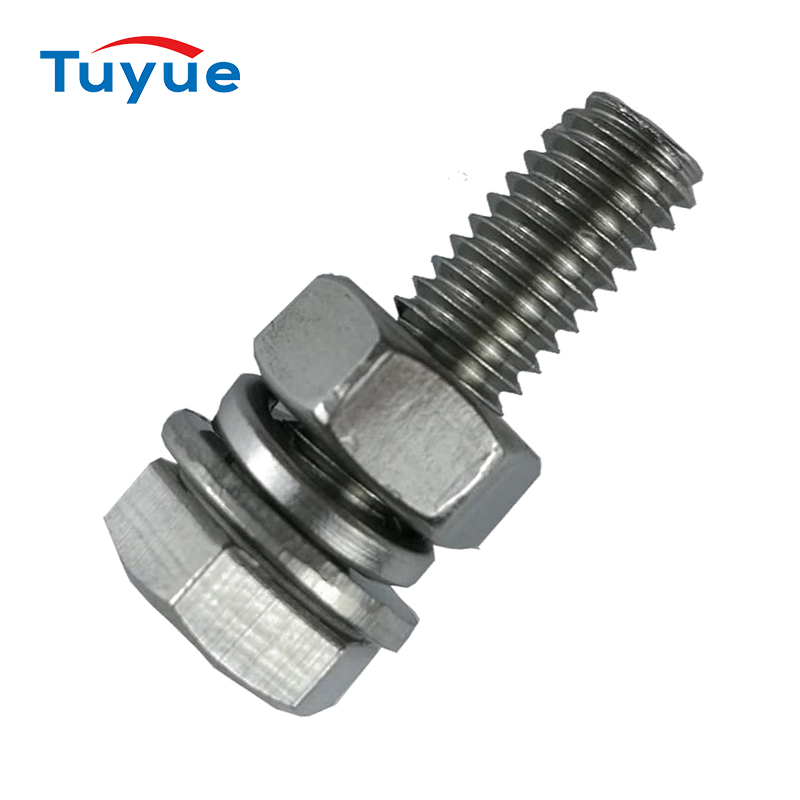
The assemble bolt is the primary load-transfer component connecting panel frames to mounting rails or structural purlins. In solar applications, assembly bolts typically follow metric standards (M6, M8, M10, M12), with property class 8.8 or A2-70 stainless steel being most common. Torque specifications are critical — under-torqued connections loosen under thermal cycling and vibration, while over-torquing can damage aluminum frames. Typical installation torque for M8 solar bolts ranges from 12–18 Nm depending on material and coating.
The T bolt is specifically designed for insertion into the T-slot channels of aluminum mounting rails. It allows tool-free positioning along the rail before locking, making installation faster and more flexible. T-bolts are typically used in combination with spring nuts or flange nuts and are particularly common in utility-scale and commercial rooftop systems where rail alignment must be adjusted on site. The hammer-head profile must match the rail slot width precisely — typically 6mm or 8mm profiles — to ensure secure engagement.
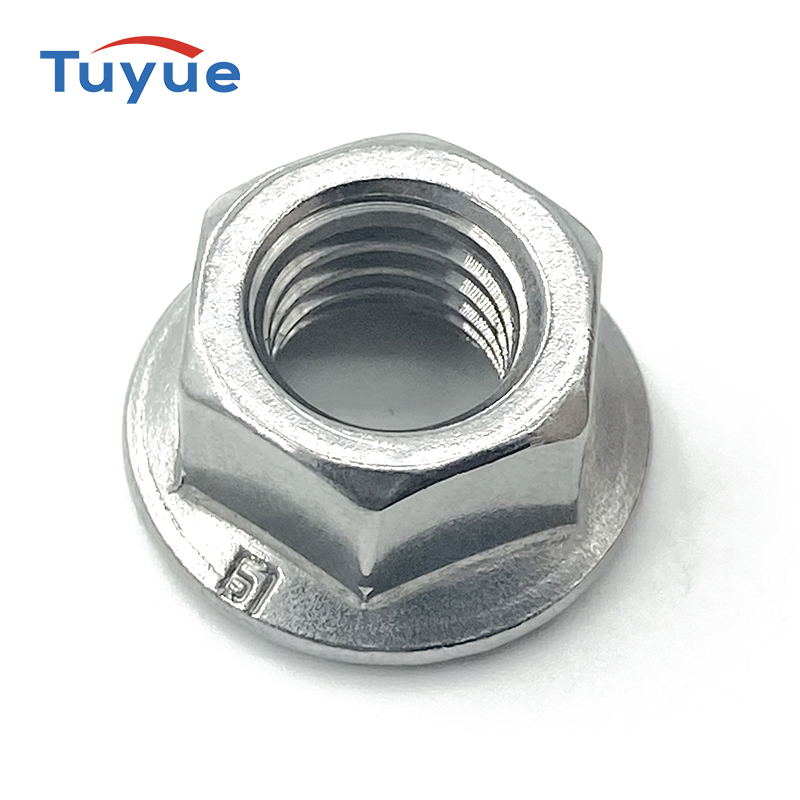
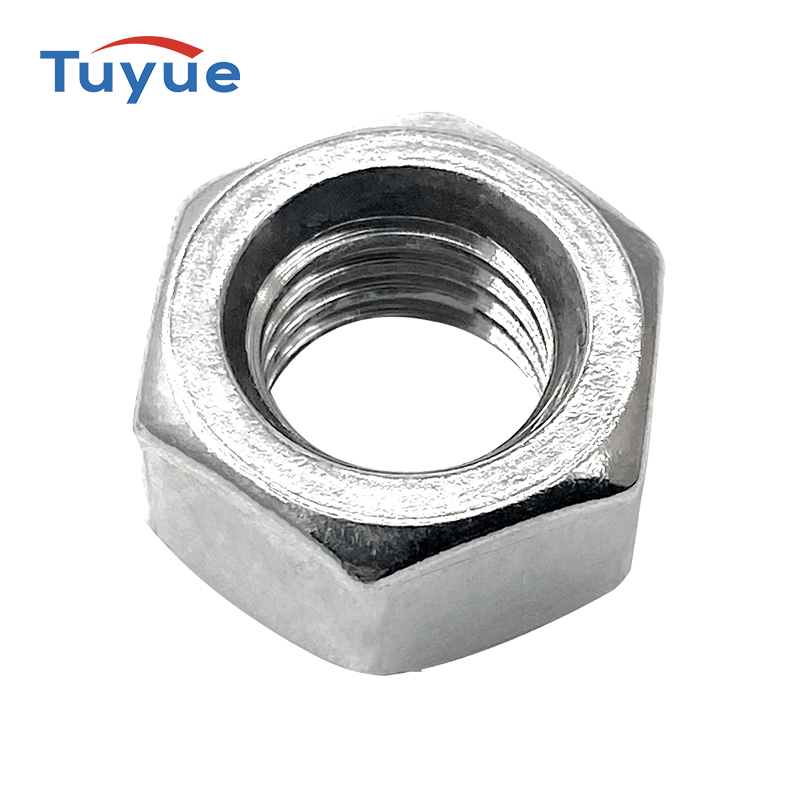
The standard hex nut provides the clamping force in bolt-nut assemblies throughout the PV structure. For solar applications, prevailing torque nuts or nylon-insert locknuts (nylock) are preferred to resist loosening from wind-induced vibration. The hex flange nut adds an integrated washer flange, distributing clamping load over a wider surface area — critical when tightening against aluminum rail or thin sheet metal substrates to prevent indentation and galling.
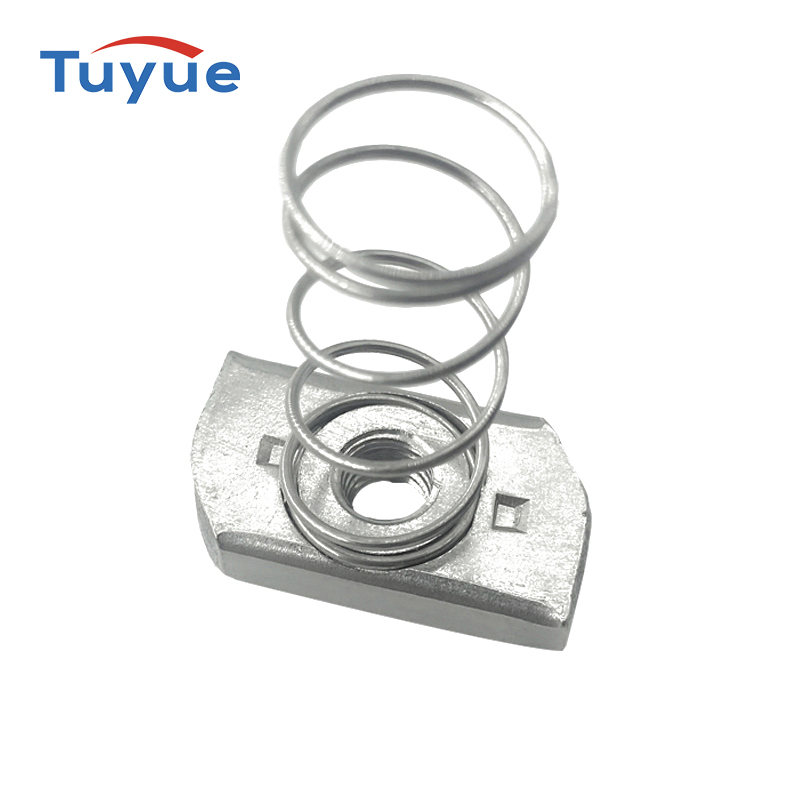
The spring nut is a specialized fastener that snaps into a strut channel or mounting rail, self-retaining for hands-free positioning during installation. It compresses under bolt load to grip the channel walls, resisting both axial pull-out and rotation. Spring nuts are widely used in commercial and industrial rooftop PV systems with unistrut or C-channel racking. Material selection between carbon steel with zinc plating and stainless steel depends on the corrosion environment.
The spring washer (disc spring or helical spring washer) compensates for bolt tension loss caused by thermal expansion and contraction. In PV systems operating across temperature ranges of −40°C to +85°C, thermal cycling produces significant differential expansion between dissimilar metals (e.g., steel bolts in aluminum rails). Spring washers maintain a minimum preload, preventing joint loosening without the need for re-torquing. DIN 127 and DIN 6796 are the most referenced standards.
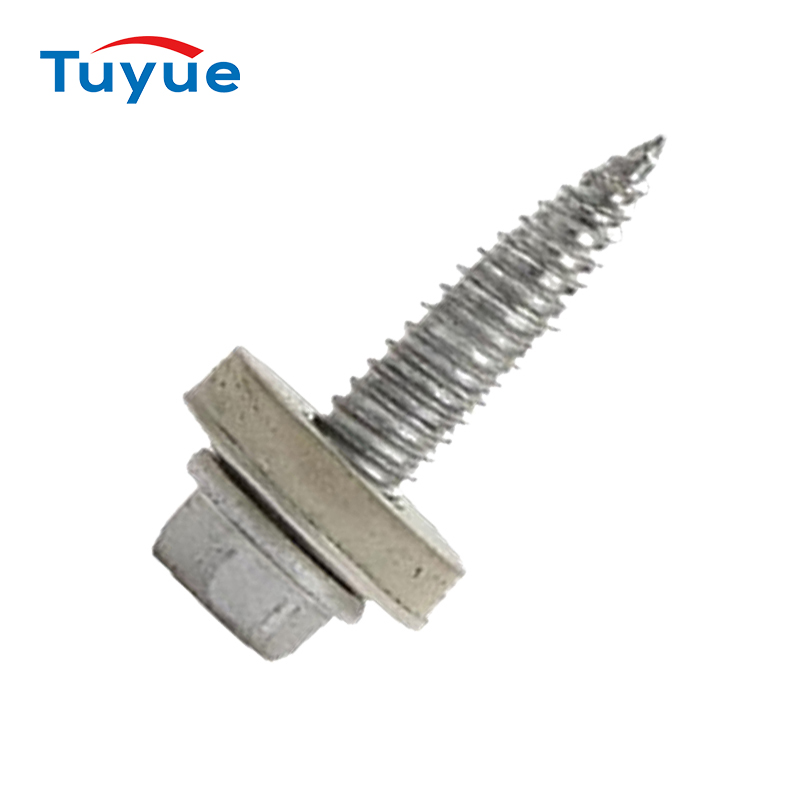
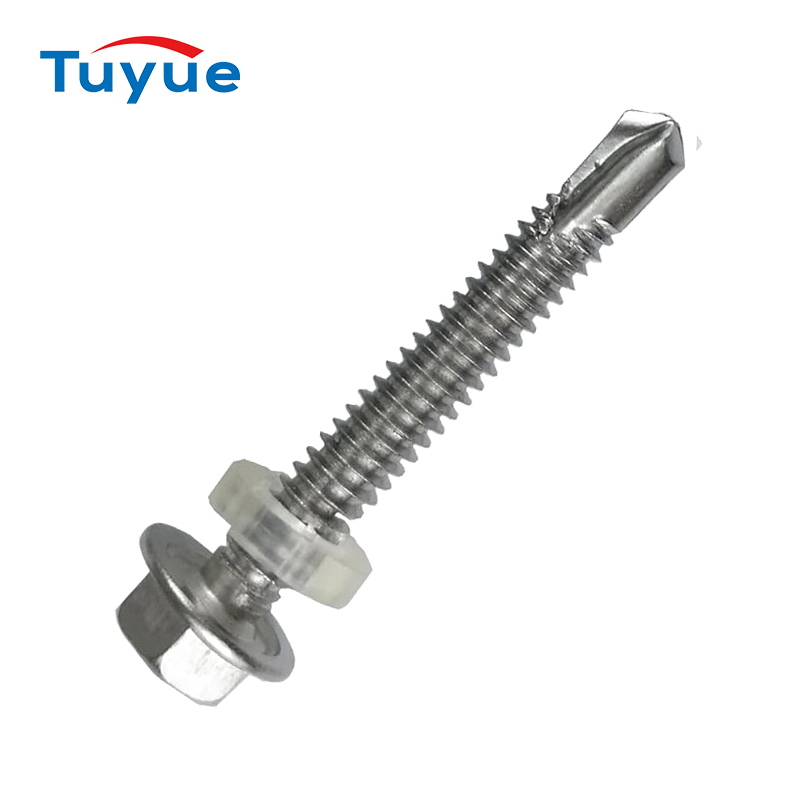
The hex washer drilling screw (also called a TEK screw or self-drilling fastener) penetrates and threads into metal substrates in a single operation — no pilot hole required. Point styles #3 and #5 are standard: #3 is designed for light-gauge steel (up to 4.8mm), while #5 can penetrate heavy structural steel up to 12.7mm. In solar installations, these screws secure rail mounting brackets to steel purlins, metal roofing panels, or structural steel frames. The hex washer head with a sealing EPDM washer beneath prevents water ingress at each roof penetration point.
The bi-metal screw solves the specific challenge of drilling through stainless steel cladding or hard substrates while maintaining a corrosion-resistant body. It features a carbon steel drill point (for cutting hardness) bonded to a stainless steel shank and head (for corrosion resistance). This design eliminates the need to source separate drill bits and fasteners, reducing installation time. Bi-metal screws are the preferred choice for attaching brackets and rails to stainless-clad or hard-coated metal roofs.
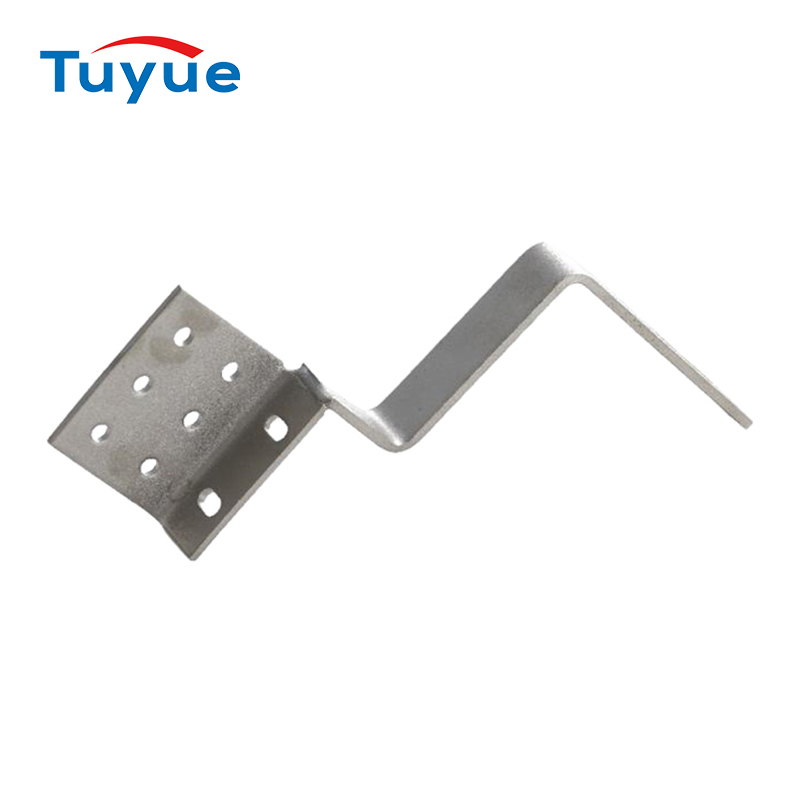
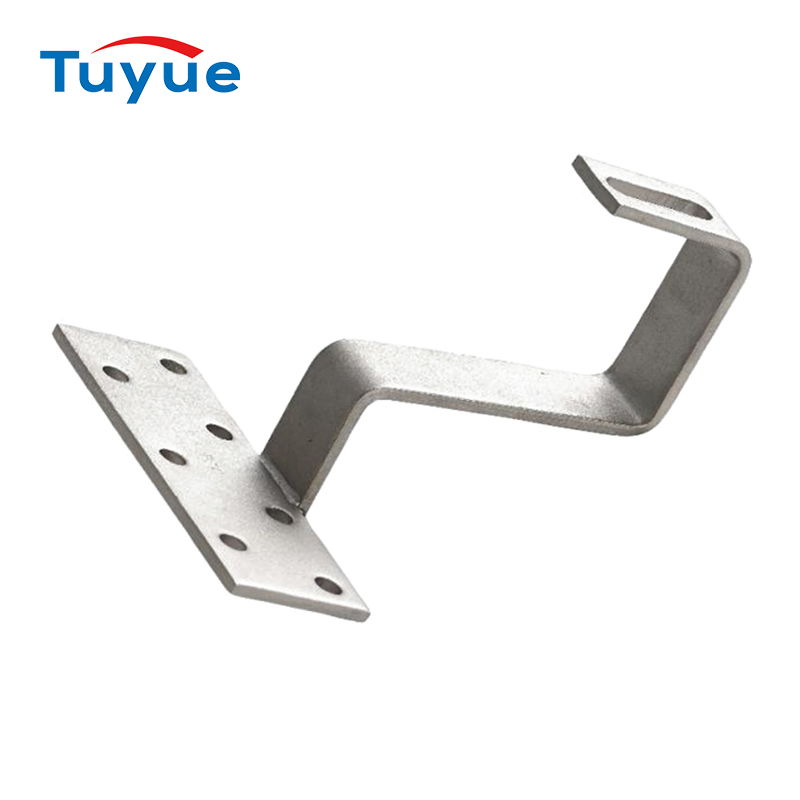
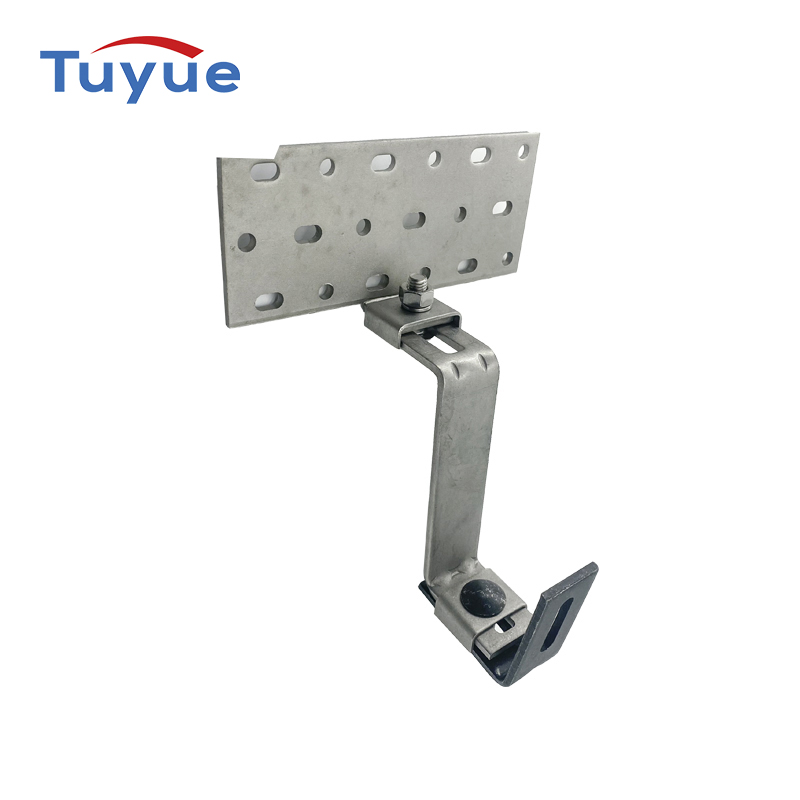
The solar hook is a load-bearing anchor hardware piece designed for tile and curved-roof solar installations. It inserts under roof tiles and attaches to the roof rafter, providing a mounting point for rails without violating the tile's waterproof integrity. Different hook profiles exist for different tile formats: flat tile hooks, Roman tile hooks, and S-profile hooks. The hook must be rated to the combined dead load of the module plus dynamic wind uplift force — typically designed to withstand 3–5 kN per hook depending on local wind codes (ASCE 7, EN 1991-1-4). Tuyue offers multiple solar hook designs to accommodate different roofing profiles, including a third variant for specialized tile geometries.
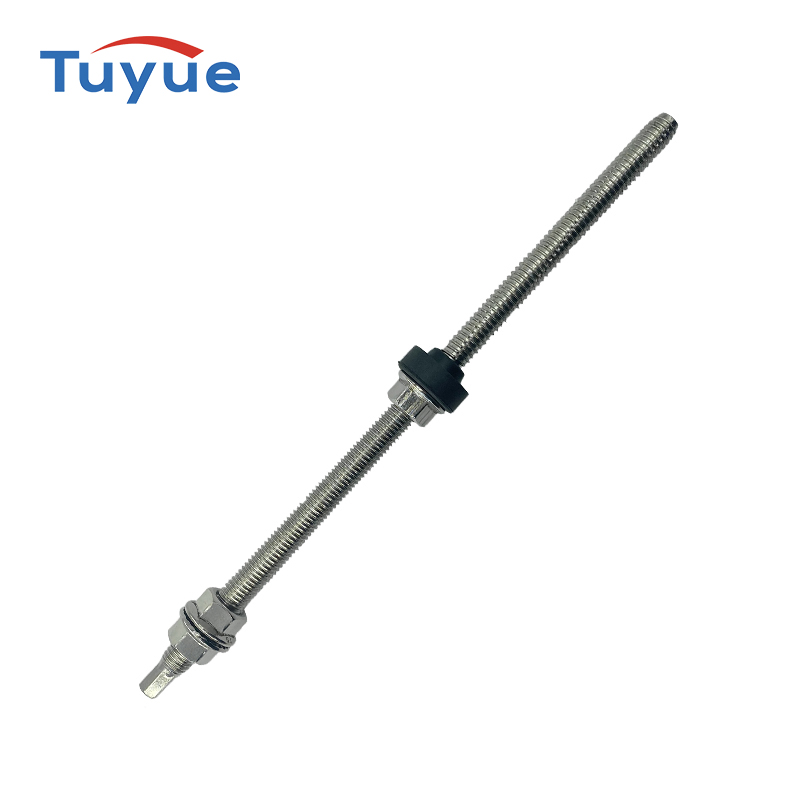
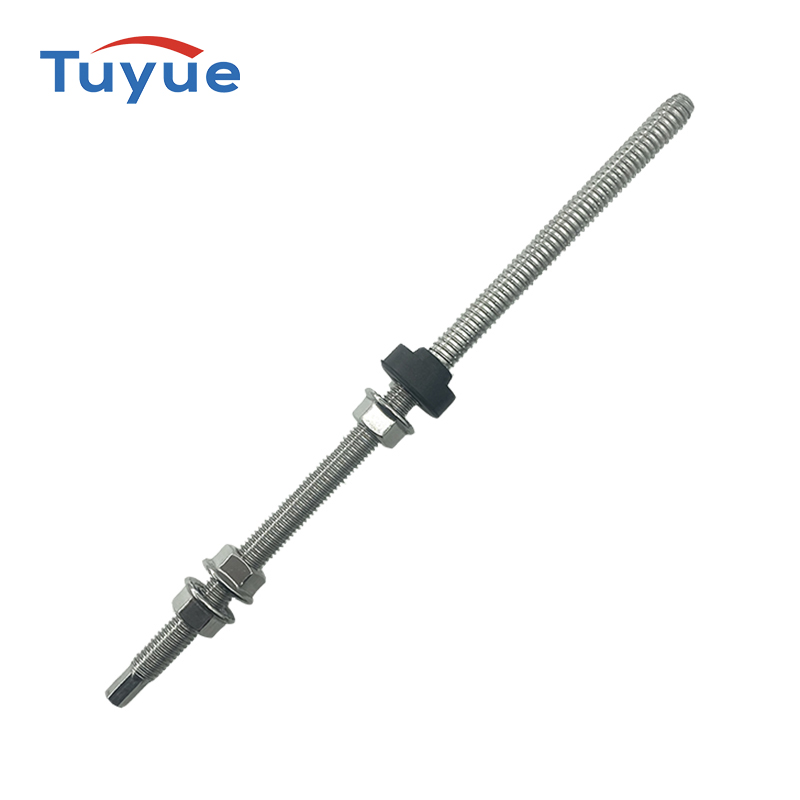
The solar hanger bolt is a dual-threaded fastener with wood-screw threads on one end (for penetration into roof rafters) and machine-thread on the other (for rail attachment). It is the primary anchor point in residential shingle-roof PV installations. Penetration depth into the rafter must meet local code requirements — typically a minimum of 38mm (1.5 inches) into solid lumber. A second variant of the solar hanger bolt with extended length is available for thicker roofing assemblies or when a flashing standoff is used. Proper torque and waterproofing sealant are mandatory at every penetration to prevent long-term water damage.
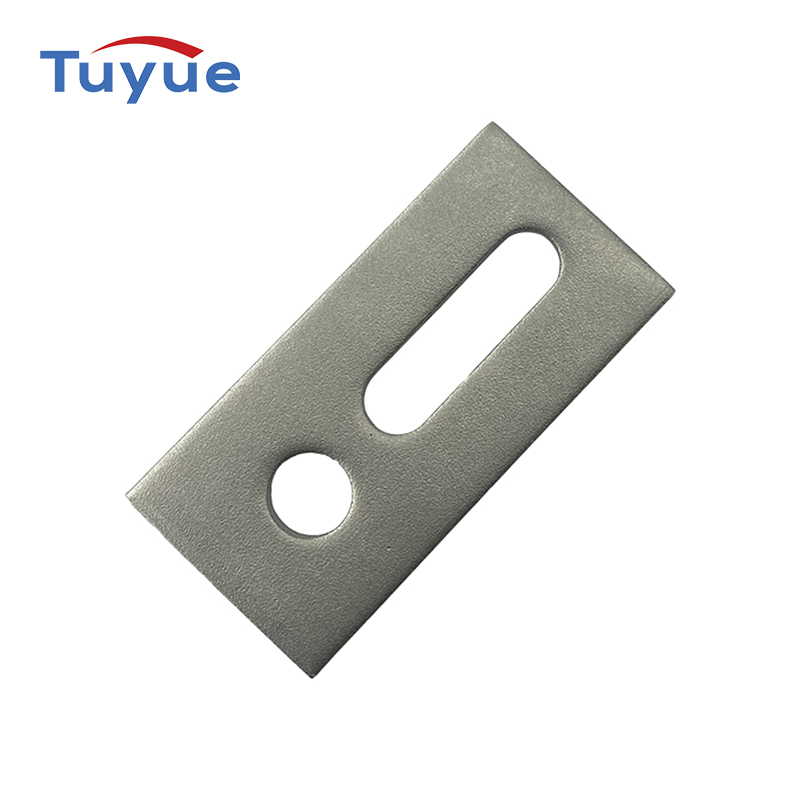
The solar adaptor is a bridging hardware component that enables compatibility between different mounting system designs or between mounting rail profiles and non-standard panel frames. In modular racking systems, adaptors allow mixed panel brands or sizes to be installed on the same rail layout. They are also used when retrofitting new panels onto legacy mounting structures. Dimensional tolerances on solar adaptors must be tight — typically ±0.2mm — to ensure consistent clamping force distribution across all interface points.
SS304 (18% chromium, 8% nickel) is the baseline specification for most solar fasteners, offering excellent atmospheric corrosion resistance. SS316 adds 2–3% molybdenum, dramatically improving resistance to chloride-induced pitting — making it the required specification for coastal installations within 1–5 km of seawater. Both grades are non-magnetic in the annealed state (relevant for certain electrical equipment proximity requirements) and have an expected outdoor service life exceeding 25 years, matching the warranty period of modern PV modules.
One of the most technically significant challenges in PV fastener design is galvanic corrosion at the interface between dissimilar metals. Aluminum mounting rails (anode) in contact with stainless steel fasteners (cathode) in the presence of electrolyte (rainwater with dissolved salts) creates a galvanic cell. While the potential difference between aluminum and stainless steel is relatively low (~0.5V), over 25 years even slow galvanic attack can weaken the aluminum frame wall to the point of structural failure. Mitigation strategies include using aluminum or anodized isolation washers, applying dielectric grease at contact interfaces, or specifying bi-metal fasteners that minimize the galvanic potential difference. This is a key reason why Tuyue's hardware and fasteners range includes both stainless steel and bi-metal options specifically engineered for solar environments.
Standard zinc-plated (electroplated) carbon steel fasteners are generally not acceptable for outdoor solar applications in most professional specifications. Electroplated zinc coatings provide only 5–12 microns of protection — insufficient for 25-year outdoor exposure. Hot-dip galvanized (HDG) fasteners with 45–85 micron zinc coatings are acceptable for inland ground-mount applications. However, HDG is incompatible with precision thread tolerances, making it unsuitable for fine-pitch M6–M8 bolts. This is why the industry standard for module-level fasteners has converged on stainless steel, reflected in certifications such as IEC 61215 durability testing protocols.
Solar fasteners for international markets are evaluated against several overlapping standards. The IEC 61215 standard (Terrestrial Photovoltaic Modules — Design Qualification and Type Approval) defines module-level durability requirements but indirectly drives fastener performance requirements through its 1000-hour damp heat (85°C / 85% RH) and thermal cycling tests. ASTM B117 (Standard Practice for Operating Salt Spray Apparatus) is the benchmark corrosion test referenced in most procurement specifications — professional-grade solar fasteners should pass a minimum 500-hour neutral salt spray test without red rust, with 1000 hours preferred for coastal applications. In the European market, EN ISO 3506 defines mechanical properties of stainless steel fasteners specifically. Tuyue's manufacturing capability covers products meeting these international standards, supporting global project requirements across different climate zones.
Fastener torque is one of the most critical and most frequently neglected aspects of solar installation. IEC 62548 (Design Requirements for PV Arrays) emphasizes that all fasteners must be installed to the manufacturer's specified torque using calibrated torque wrenches. Pneumatic impact drivers — commonly used by installation crews — cannot reliably deliver consistent torque and should not be used for final module clamping. Torque values for common solar fasteners:
M6 stainless bolt to aluminum rail: 7–10 Nm
M8 stainless bolt to steel structure: 18–25 Nm
Hanger bolt to rafter (5/16" diameter): 10–15 Nm
Self-drilling screw (No. 14) to steel purlin: 8–12 Nm
Re-torquing inspection is recommended at 6 months post-installation, as bolt relaxation during the initial thermal cycling period can reduce preload by 15–30%.
Every penetration through a roofing membrane or tile surface created by a hanger bolt or hook must be sealed with code-compliant flashing and sealant. Professional-grade butyl-based or silicone sealants rated for UV and thermal exposure (−40°C to +150°C) are required. The sealant must be applied around the penetration before the final torquing of the hanger bolt to ensure complete void filling. Improperly sealed penetrations are among the leading causes of rooftop PV warranty claims.
Mid clamps and end clamps distribute clamping force across the module frame edge. The contact pressure between clamp and frame must remain within the frame manufacturer's specified range — typically 5–15 MPa — to avoid frame deformation while providing sufficient friction to resist module slip under wind load. In high-wind regions (basic wind speed >160 km/h per ASCE 7), additional fastener points or higher-rated clamps are required. The stamping part iron framing steel corner components in Tuyue's range provide supplemental structural reinforcement at frame corners for demanding load conditions.
NEC Article 690 (US) and IEC 62548 require that all metallic components of the PV array — including mounting rails, frames, and racking structures — be electrically bonded and grounded. While standard fasteners are not grounding devices, the mechanical connection they create between conductive components is part of the bonding path. Grounding lugs, bonding jumpers, or listed module-level grounding clips must be integrated into the mounting system at specified intervals. Fastener material and coating must not create a high-resistance oxide layer at bonding interfaces — this is an additional reason why bare stainless steel contact surfaces are preferred over painted or heavily coated fasteners in bonding locations.
The primary anchor is the solar hanger bolt driven into roof rafters at 406–610mm (16"–24") rafter spacing. Solar hooks are used for tile roofs to preserve the waterproof tile layer. Rails are then attached with T-bolts and spring nuts. Module-to-rail clamping uses mid clamps and end clamps fastened with stainless steel bolt nut screws washers. Self-drilling screws are avoided at the module-rail interface to allow future panel replacement.
Ballasted or mechanically attached systems are standard. Mechanically attached systems use self-drilling screws through the membrane into structural decking with EPDM-backed sealing washers. Rail-to-bracket connections use T-bolts and flange nuts. Bi-metal screws may be used where the membrane cap sheet includes a stainless or aluminum facing layer.
Driven pile or helical anchor foundations connect to torque tubes or fixed-tilt tables using high-strength bolt assemblies (property class 8.8 or 10.9). Flange connections at pile tops use hex bolts with spring washers and prevailing-torque nuts. Module attachment follows rail-and-clamp methodology identical to rooftop systems. Corrosion protection for below-grade components requires HDG or epoxy coating rather than stainless steel due to soil electrolyte exposure.
Standing seam roofs use non-penetrating S-5! style clamps that grip the seam mechanically without puncture. Corrugated metal roofs require hex washer drilling screws through the corrugation crown into purlins. Roofing screws and drilling screws in Tuyue's product range are specifically sized and coated for these applications, with EPDM bonded washers providing the water-tight seal at each penetration.
The shift to 182mm (M10) and 210mm (G12) silicon wafer formats has increased module dimensions and dead weights substantially — typical commercial modules now weigh 25–35 kg. Combined with higher-efficiency bifacial modules that require elevated mounting (increased wind leverage), the structural loads on fasteners have increased approximately 20–30% compared to 60-cell era systems. This drives demand for higher property class bolts and refined torque specifications.
Bifacial modules require rear-surface clearance to allow albedo light capture, which means mounting clamps cannot use traditional full-width bottom rail support in some configurations. This has accelerated development of frameless module clamps and bonding adhesive mounting — both of which place new chemical and mechanical requirements on interfacing hardware components.
Agrivoltaic (solar + agriculture) and floating solar (FPV) installations expose fasteners to dramatically more aggressive environments — high humidity, fertilizer chemicals, and in FPV systems, continuous water contact. SS316L (low-carbon variant of SS316) and duplex stainless steel (e.g., 2205) are increasingly specified for these applications. Tuyue's stainless steel product range, including aluminium steel and SS blind rivets, supports the joining needs of these next-generation solar environments.
Large EPC contractors increasingly demand pre-assembled fastener kits — bolts, nuts, and washers pre-assembled per connection point — to reduce on-site labor and eliminate installation errors. This trend requires fastener manufacturers to invest in kitting capabilities and precise component matching, an area where established suppliers with comprehensive product ranges like Tuyue have a competitive advantage.
When specifying solar fasteners for project procurement, the following technical criteria should be addressed in the specification document:
Material grade and standard (e.g., A2-70 per ISO 3506, or SS316 per ASTM A276). Corrosion test requirement and minimum hours per ASTM B117 or equivalent. Thread standard (ISO metric or UNC/UNF), pitch, and tolerance class. Dimensional standards (DIN, ISO, ASME/ANSI). Coating type and thickness if applicable (passivation, electrolytic polishing). Lot traceability and material certification (EN 10204 3.1 or 3.2 mill certificates). Packaging and kitting requirements for site installation.
For projects requiring a broad scope of hardware from a single accountable supplier, Tuyue's integrated hardware and fasteners product line covers the full assembly — from roof penetration anchors to module-rail clamp hardware — backed by 20 years of manufacturing expertise and export experience from Jiaxing, Zhejiang, China.