Securing Every Connection
Trust Built on 20 Years of Expertise
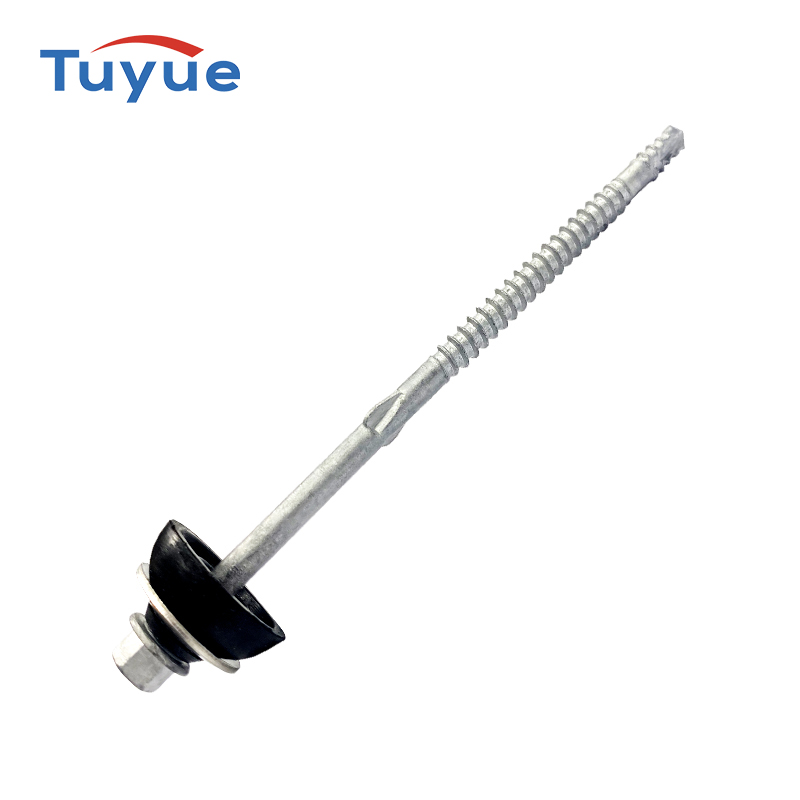
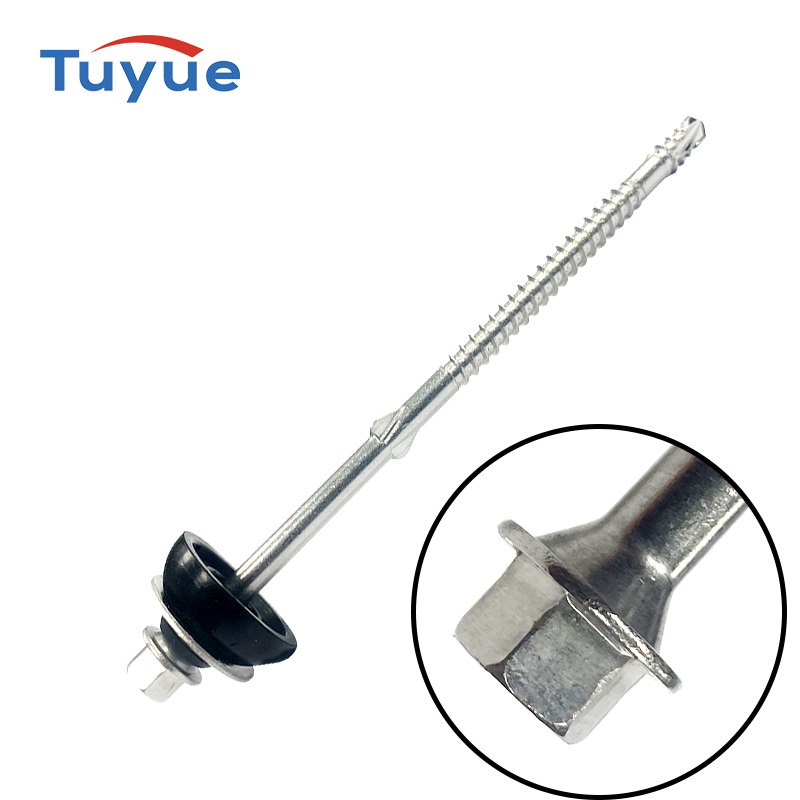
Roofing and drilling screws are among the most performance-critical fasteners in modern construction. Specifying the wrong type, coating, or dimension does not merely cause installation inconvenience — it directly affects a building envelope's ability to resist wind uplift, water ingress, and long-term structural fatigue. As building codes tighten globally and metal construction expands into solar, industrial, and modular applications, understanding the engineering principles behind these two screw families has become essential for contractors, procurement engineers, and project specifiers. Zhejiang Jiaxing Tuyue Import and Export Company Limited, established in Jiaxing, Zhejiang and operating with over 20 years of fastener manufacturing and export experience, supplies a full range of roofing and drilling screws to more than 200 clients across international markets. This guide covers the technical depth that professionals need when selecting from this category.
Although both product families share a self-drilling tip and a threaded shank, they are engineered around fundamentally different performance priorities. Roofing screws are optimised for weather resistance, panel retention, and long-term watertight integrity. Their defining feature is the bonded sealing washer, most commonly EPDM (ethylene propylene diene monomer) rubber, which compresses under the screw head during installation to form a continuous seal around the penetration point. Drilling screws, by contrast, are optimised for penetration efficiency and structural connection speed in metal-to-metal and metal-to-timber assemblies. They typically do not carry a sealing washer and are selected on the basis of drill-point class, thread pitch, and shear strength rather than weatherproofing.
This distinction matters in procurement. Substituting a standard hex head drilling screw for a roofing screw in a metal cladding application leaves every fastener hole as a potential water ingress point. The reverse substitution — using a roofing screw with an EPDM washer in a structural framing connection — adds unnecessary cost and does not improve joint strength.
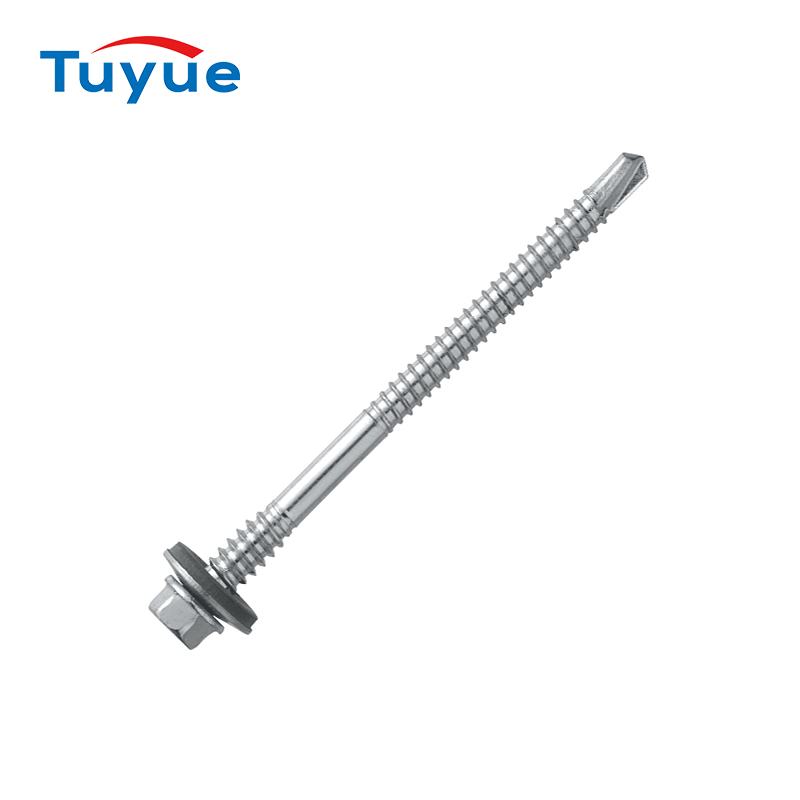
The drill point is the element that defines a self-drilling screw's capability. Point classification follows the number of steel layers the tip can penetrate before the thread engages. A point 1 tip is rated for sheet metal up to approximately 0.9 mm thick. A point 3 tip handles combined steel thickness up to around 4.8 mm and is the standard for light gauge steel framing. Point 4 and point 5 tips, designed for structural steel purlins and heavy sections up to 12.7 mm, require a larger flute geometry and harder tip steel to maintain drilling performance without deflection or premature fracture.
Selecting a point class below the substrate requirement results in tip fracture before the thread can engage. Selecting a higher point class than necessary wastes cost and can result in oversized holes that reduce pull-out strength. The hex head drilling screw range at Tuyue covers the standard point configurations for structural and light-gauge steel applications.
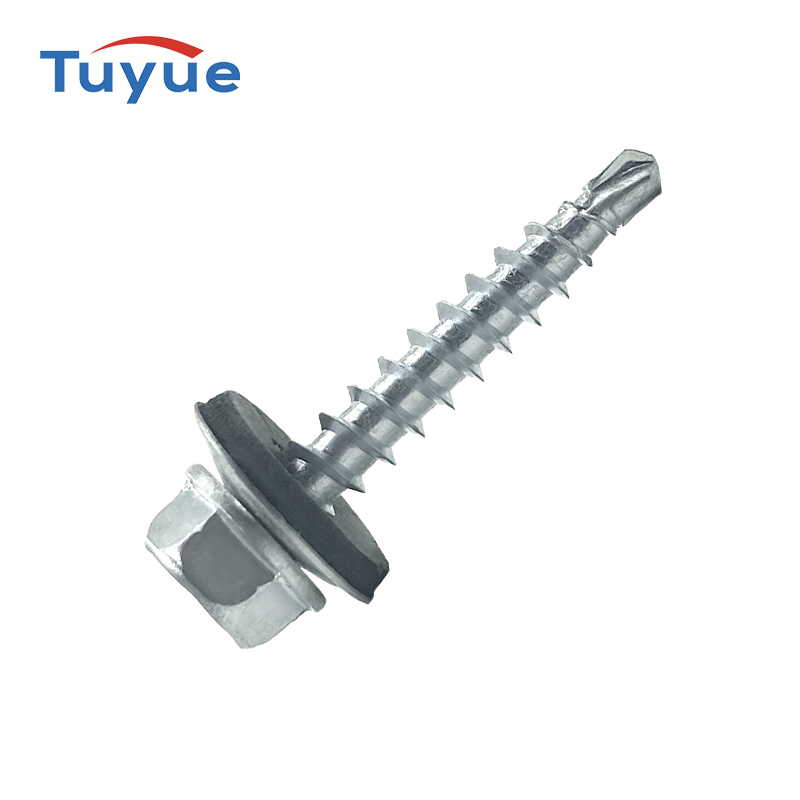
The roofing screw with EPDM washer is the industry-standard configuration for metal roof and wall cladding worldwide. The EPDM compound offers UV resistance, ozone resistance, and thermal stability across a range of approximately -40°C to +120°C, making it the preferred elastomer over neoprene in exposed roofing environments where UV degradation and thermal cycling are the primary failure mechanisms.
Washer compression is a critical installation parameter. Under-torqued installation leaves the washer incompletely seated, creating a gap that allows capillary water entry. Over-torqued installation crushes the washer beyond its elastic range, causing permanent deformation, cracking, and eventual loss of seal integrity. Most roofing screw installations specify a torque range of 4–8 Nm for standard 4.8 mm hex head configurations, with the installed washer showing uniform radial compression without visible cracking or extrusion.
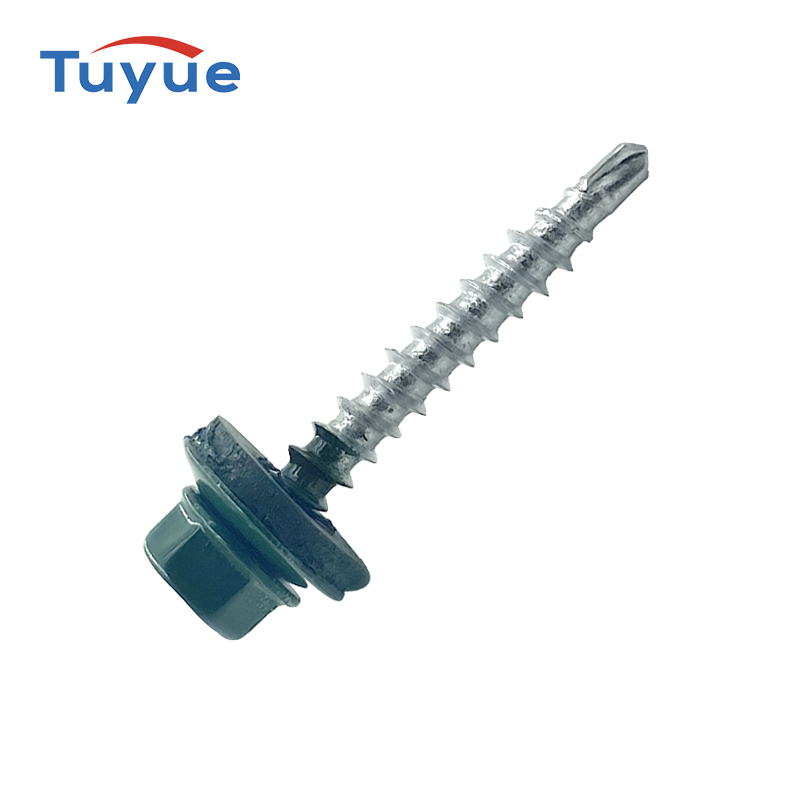
Tuyue supplies two primary EPDM roofing screw configurations. The roofing screw with EPDM washer in standard head finish suits most industrial and commercial roofing applications. The roofing screw with EPDM washer and painted head colour-matches the washer and head to the roofing panel for aesthetic consistency in architectural and residential projects.
For roofing on profiled (corrugated or trapezoidal) metal sheets, the spoon-point configuration is technically superior to a standard drill-point tip. The hex flange self-drilling screw with spoon point and rubber washer uses a curved tip geometry that follows the sheet surface during entry, maintaining perpendicular insertion without deflection on the sheet slope. Deflection at the tip entry point is the primary cause of angled installation, which prevents uniform washer compression and leads to asymmetric sealing.
Standard carbon steel self-drilling screws are case-hardened through a combination of material selection and heat treatment. However, the same hardness that enables effective drilling through steel also makes the screw body brittle and susceptible to hydrogen embrittlement under certain plating conditions. Bi-metal screws resolve this by using a hardened high-speed steel (HSS) drill tip welded or press-fitted to a stainless steel or lower-carbon steel body. The result is a screw that retains the drilling performance of hardened tip steel while the body maintains ductility, corrosion resistance, and resistance to fracture under cyclic loading.
Bi-metal technology is particularly important in solar and coastal roofing applications where the fastener must remain corrosion-resistant throughout a 25–30 year service life. Tuyue offers two critical bi-metal configurations. The Ruspert hex flange head bi-metal self-drilling screw with EPDM washer combines a bi-metal core with Ruspert ceramic-polymer coating for maximum corrosion performance in industrial and coastal atmospheres. The SS304/SS316 hex flange head bi-metal self-drilling screw with pointed cut tail uses fully austenitic stainless steel in the body for marine-grade corrosion resistance.
Ruspert is a ceramic-zinc composite coating system applied in multiple layers: a zinc phosphate base, a chromate intermediate, and a ceramic topcoat. The combined system produces a coating with salt spray resistance exceeding 1,000 hours per ASTM B117, with premium grades tested beyond 2,500 hours — a threshold that standard electro-galvanized screws (typically 120–480 hours) cannot approach. Ruspert is specified for roofing and structural screws in coastal zones (within 1 km of the sea), aggressive industrial atmospheres, and any application where projected service life exceeds 15 years without maintenance access.
A critical installation detail specific to Ruspert-coated screws is that the coating must not be compromised during driving. Impact driver settings should be reduced relative to those used with zinc-plated screws, as excessive rotational speed abrades the ceramic topcoat at the socket recess. Bit wear is also more significant with Ruspert screws due to the abrasive nature of the ceramic layer. For full installation guidance, refer to the Tuyue blog article: Handling and Installation Considerations for Ruspert-Surfaced Screws.
The hexagon washer head Ruspert self-drilling screw with double thread is a specialised configuration designed for faster pull-down speed in high-volume roofing installations. The double-lead thread reduces the number of rotations required per fastener by approximately 40% compared to single-lead thread designs, directly reducing installation cycle time on large-area roofing projects.
Wing-tip screws carry small projecting blades (wings) at the base of the drill point that ream a clearance hole through timber or other soft substrate before the screw shank reaches the steel below. Without wings, the thread would engage the timber and begin to pull it down before the tip had fully penetrated the steel, creating a gap between the timber and the steel at the joint. The wings break off cleanly on contact with the steel surface, leaving the thread free to engage only the steel and draw the timber tight during the final fastening stroke.
Two wing geometries serve different substrate profiles. The flat head drilling screw with wing with cutting uses a straight-edged wing that shears through wood cleanly, suitable for dense hardwood and engineered timber products. The flat head drilling screw with wing with rib uses a ribbed wing profile that provides a wider clearance path and reduces binding in softer or fibrous timber species. Both configurations are also available with wing nibs under the head to prevent over-sinking in timber, a feature visible in the Phillips flat head self-drilling screw with wing nibs under the head.
The rising demand for wing-type self-drilling screws in mixed-material assemblies, including solar panel subframes on timber roof decking, is covered in the Tuyue blog: Rising Demand for Advanced Self-Drilling Screws.
Head type and drive geometry determine the maximum achievable installation torque, the aesthetic result, and the compatibility with available installation tools on site.
Hex head screws, driven by box-end sockets or impact drivers, deliver the highest torque transfer of any common drive system and are the standard for structural and roofing applications. The wide bearing surface of a hex flange head distributes clamp load over a larger area, reducing the risk of pull-through in thinner gauge sheeting.
Pan head and bugle head configurations using Phillips or Phillips/Torx combined drives are better suited to cladding, drywall, and interior applications where flush or countersunk installation is required. The cross recessed bugle head drilling screw provides a countersunk profile that sits flush with the sheet surface without a protruding head. The pan head Phillips/Torx self-drilling screw accepts either drive type, providing tool flexibility on sites where both bit systems are in use.
The modified truss head drilling screw uses an extra-wide, low-profile head that distributes bearing load over a significantly larger area than a standard pan head. This configuration is specified for thin or fragile substrates — polycarbonate sheeting, composite panels, and insulated cladding systems — where a concentrated head bearing would cause pull-through or cracking.
The button head self-drilling screw offers a domed, low-profile head with a positive Phillips drive and is commonly used in visible assembly applications where a clean, rounded head profile is preferred over the utilitarian appearance of a hex head.
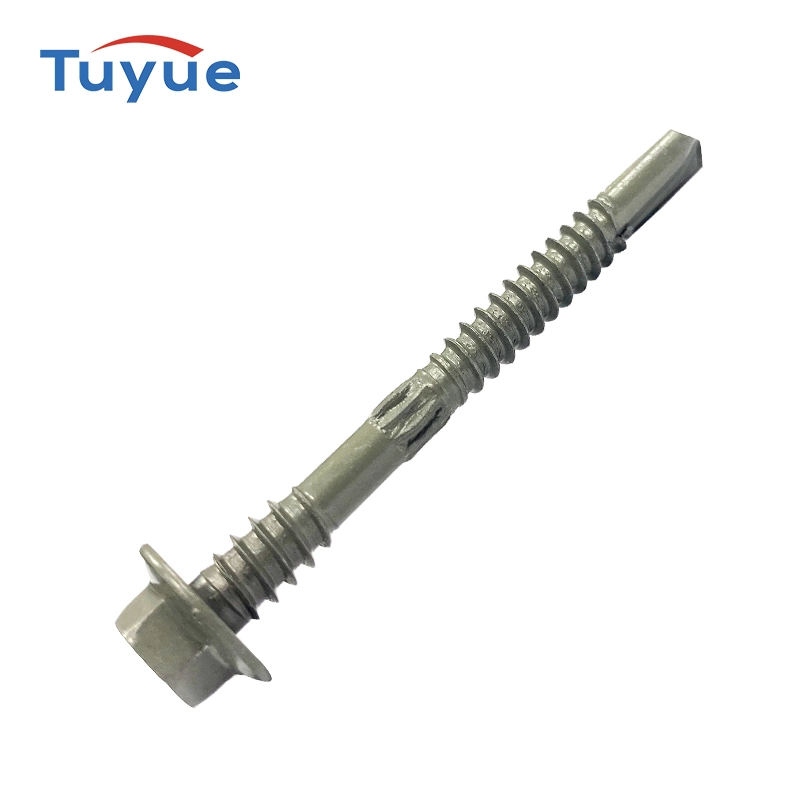
Sandwich panels — composite assemblies consisting of two steel facings bonded to a rigid foam or mineral wool core — present a unique fastening challenge. A standard self-drilling screw entering a sandwich panel must penetrate the outer steel skin, pass through a compressible insulating core, and engage the inner steel skin or a steel purlin beneath. If the screw thread engages the outer skin before the drill tip has cleared the core, the thread pulls the outer skin inward, compressing the insulation and distorting the panel face. Sandwich panel screws address this with an unthreaded shank zone beneath the head that allows the outer skin to remain clamped without thread-induced distortion during penetration through the core.
The sandwich panel drilling screw in the Tuyue range is engineered specifically for this application and is directly relevant to the growing market for insulated metal panel systems in commercial and industrial construction.
Light gauge steel (LGS) framing systems require dedicated screw types for different joint configurations. Stud-to-track connections, web stiffener installations, and bridging clips each have specific pull-out and shear load requirements. The pan framing self-drilling screw uses a fine thread pitch optimised for thin-gauge steel connections (typically 0.5–1.5 mm thickness) where coarse-thread screws would strip the formed thread before achieving full clamp load. Fine thread engagement in thin gauge steel relies entirely on the quality and consistency of the formed thread — a variable that depends directly on manufacturing precision in the screw's thread-forming zone.
Atmospheric corrosivity categories defined by ISO 9223 (C1 through C5 and CX for marine/offshore) provide a framework for selecting fastener coatings. C1 (indoor, dry) environments are adequately served by standard zinc electroplating. C2–C3 (rural to urban/industrial) environments require hot-dip galvanizing or a chromate-treated zinc system. C4–C5 (industrial and coastal) environments demand high-performance coatings: Ruspert, hot-dip galvanized Class C per AS 3566, or stainless steel A4-316. CX environments (offshore, chemical exposure) require fully stainless A4 or Duplex grade materials.
Painted head roofing screws offer an additional aesthetic layer where the head colour is matched to the panel system. However, the paint on the head does not contribute meaningfully to corrosion protection of the shank or thread — the underlying base coating or material specification remains the primary corrosion defence. Over-torquing coloured-head screws removes the paint at the socket contact area and accelerates crevice corrosion at the recess.
The global market for high-performance roofing and drilling screws is undergoing a structural upgrade. Industry data cited in the Tuyue blog post The New Science of Roofing and Drilling Screws projects the construction fastener market will exceed $14 billion by 2028, driven by metal-frame construction growth, residential roofing activity in North America, and infrastructure expansion in Southeast Asia. Within this growth, self-drilling screws are recording the fastest volume gains of any fastener sub-category.
The same industry analysis identifies fastener substitution as a significant technical risk: unspecified substitutions appeared in nearly one in four mid-size commercial roofing projects surveyed in 2025, with under-rated or incorrectly specified screws repeatedly appearing in forensic analyses of failed roofing assemblies after weather events. This reinforces the importance of complete specification — including material grade, coating class, drill-point number, thread pitch, and head type — rather than procurement based on gauge and length alone.
Twin-lead thread geometry, now commercialised in several high-volume roofing screw products including Tuyue's double-thread Ruspert configuration, distributes pull-out load across a broader thread contact area and reduces installation rotation count, improving both structural performance and installation speed simultaneously. For further reading on hex drilling screw demand and spoon point technology, see The Rising Demand for Hex Drilling Screws in Modern Construction and Manufacturing and The Benefit of Self Drilling Screws Spoon Point in Using.
When specifying or sourcing from this category, engineers and procurement managers should confirm: substrate material and thickness (to determine drill-point class), combined layer thickness where multiple materials are stacked, atmospheric corrosivity category per ISO 9223 (to determine coating), required pull-out and shear load ratings (to determine shank diameter and thread form), sealing requirement (to determine washer type and material), head type and drive (to match installation tools on site), and whether the joint is permanent or will require future disassembly.